(Jackson Street) Books on 7th is around the corner and on the internet tubes. We strive to be your full-service new and used bookstore, emphasizing good literature, progressive politics, and, of course, books about baseball. Opened in Hoquiam October 1, 2010
Showing posts with label paranoid style. Show all posts

Friday, May 21, 2010

Department of Book Reports: The Paranoid Style in American Politics: Do Androids Dream of Electric Sheep?


This week we explore a book where the Apocalypse meets the paranoid. Do Androids Dream of Electric Sheep, Philip K. Dick's novel of the future, and the literary inspiration of the movie Blade Runner, was originally published in 1968. Dick himself was a prolific writer, having written some 40 plus novels in his lifetime, and many more short stories. His books were all in the science fiction genre and he became the first sci-fi author to be included in the Library of America series. Among the many themes Dick explored, one of the most important is the question of what makes us human? What makes us real and what is fake.

And, indeed, this is what Electric Sheep is about. In spite of the many differences between the book and the movie (the phrase Blade Runner never is used by Dick, and in fact, was a borrowing by the screenwriters from William S. Burroughs), the plot outlines are similar. Rick Deckard is bounty hunter, living in a post-Apocalyptic United States, who specializes in "retiring" replicants, human synthesized androids. Six (four in the movie) replicants have escaped from the off-world and have returned to Earth. Deckard, a man who once owned a live sheep which has died of tetanus, and has replaced it with a sheep replicant, now must find the replicants and destroy them.

The test used to detect androids is called Voight-Kampff, which measures certain bodily responses to a series of questions and by which a bounty hunter can determine whether the respondent is a replicant; replicants are incapable of empathy. The new, improved Nexus androids are otherwise indistinguishable from humans. Living in a world where one doesn't know if the person next to you is "real" or "fake", and with a powerful, totalitarian government, one could easily be a bit paranoid. Deckard, at least in the book, displays his empathy. He feels empathy for his prey. In a book (and movie) as richly textured and felt as Do Androids, I could write another book explicating it's many facets. This feature is the one I most wanted to emphasize. Empathy. Not important? Perhaps you'll remember the Sotomayor hearings last year and the Republican objections to her "empathy" as being an insufficient reason to placing her on the court.

The movie Blade Runner, as I've mentioned, differs in many details from the book. But I love it. It is lush in its visuals, and the story remains complex, and the moral issues it raises remain important. The cast, the direction with an incredible film score by Vangelis, bears many repeated viewings. I see something new in it each time. There are a couple of books I can recommend: Blade Runner by Scott Bukatman (British Film Institute) is a good scholarly look at the film. Paul M.Sammon's Future Noir: The Making of Blade Runner (HarperCollins) is a great history of the film's production.

And I'll leave you with this. The clip is the climax of the film wherein the replicant leader, Roy Batty, saves Deckard from falling to his death. and as Batty dies, delivers his "I've seen things..." speech. And I wonder if Batty saves Deckard because, at last, he can feel some empathy? Or does Batty save Deckard so there may be someone who will remember him?

These books are available from Jackson Street Books and other fine Independent bookstores. (Our copy of Do Androids is a scarce first paperback printing and, hence, a bit pricy...but we'd be happy to get you a good reading copy).As always, books ordered here will have a freebie publishers Advance Reading Copy included as a thank you to our blogosphere friends.

Friday, March 26, 2010

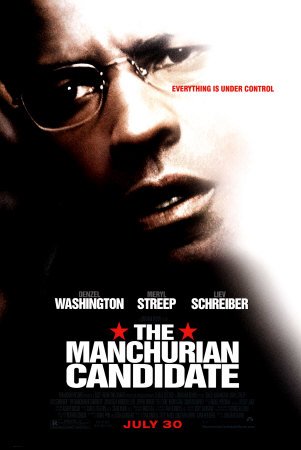
Department of Book Reports: Manchurian Candidate


The Manchurian Candidate by Richard Condon (Pocket Books $5.00) Raymond Shaw is the "kindest, bravest, warmest, most wonderful human being in the whole world", or so Captain Bennett Marco and the members of his squad in Korea all believe. And of course, they should. After all, Raymond had saved their lives in battle and had won the Congressional Medal of Honor in the process. But actually no such action ever occurred. The squad had been abducted by Chinese Communists and taken to Manchuria where all the members were "brainwashed" and Raymond himself has been turned into a political assassin. Raymond eventually returns to the States a "sleeper". And a well-connected one at that. His step-father is Senator John Iselin, who knows there are known Communists in the Defense Department. The number of Communists varies from press conference to press conference. But urged on by Raymond's mother, Senator Iselin is a risng star and headed for big things.

I read Richard Condon's The Manchurian Candidate (Pocket Books $6.99) many years ago. And in re-reading, I was reminded of how a good writer Condon, who also wrote the Prizzi novels, was. His dialogue was riveting. The descriptive passages were so good that some of it ended up as part of the screenplay (The line Frank Sinatra has, "Raymond isn't hard to like. He's impossible to like" comes from one those passages). His characaters were vivid; Raymond's mother is one of the most evil persons in literature. And the plotting is meticulous.

The Manchurian Candidate is one of the most paranoid novels of the Cold War, or any period for that matter. It is highly critical of the times wherein the action occurs and in the person of Senator Iselin, freely based on Joe McCarthy, Condon would have us believe that the Anti-Communists of the time were just as bad as the Communists they were allegedly fighting against. It is an extended metaphor for what our country had become in 1959, when the book was published, and a brave one at that. And Condon anticipates the rift between the Chinese and Russian Communists that happened in the early sixties.

I haven't seen the Jonathan Demme remake of the movie from 2004, but the 1962 film version by John Frankenheimer is fine film making. The screenplay, by George Axelrod, the playwright of "Seven Year Itch", is a faithful adaptation of the novel. (The book gives the back story of Raymond's mother,which wasn't essential for the film, and the film suggests the incest that the book makes explicit.) Frankenheimer got great performances from Frank Sinatra (who usually acted at his best with strong directors like Frankenheimer, Zinneman and Preminger), Laurence Harvey, and Janet Leigh. But the best performance, Oscar-worthy, is left to Angela Lansbury as Raymond's mother. (Incidentally Lansbury was only three years older than Harvey who played her son). The movie was shot in black and white which enhances the paranoia of both the plot and the times it portrays.

Read the book. It holds up. See the movie. It more than holds up. The Manchurian Candidate is just one fine political thriller.

As always, a book ordered from this link will have an extra freebie included: I'll find you a really cool publisher's Advance Reader Copy.

Alicia/Idella update: follow as she blogs at ShameTheBanks. She is an important voice speaking to truth.

Friday, February 26, 2010

Department of Books Reports: The Paranoid Style in American Politics

In an on-going series about the Paranoid Style in American politics in the American novel, this report will look at one of the classics in cold-war literature, Fletcher Knebel and Charles W. Bailey II's Seven Days in May (Harper and Row, 1962, a year before the Kennedy assassination, and out-of-print).

Set sometime in the early 1970's, the book has a fairly straight forward plot. The President of the United States, Jordan Lyman, with the consent of the US Senate, has conducted a disarmament treaty with the Soviet Union. The Treaty is regarded as near-treason in Pentagon, where Colonel Martin "Jiggs" Casey works as an adjutant to the Chairman of the Joint Chiefs of Staff, one General James Mattoon Scott. Over the course of about 24 hours, Jiggs, through such innocuous clues as a betting pool on the Preakness, an encounter with an old military friend who unwittingly discloses the existence of a secret army base outside El Paso, and discovering that his boss has been lying to him on other matters, begins to suspect that there is a military plot to take over the government of the United States. Col. Casey takes the information to President, and though his story is dismissed by other advisers to the President, an investigation ensues and over the next few days, the plot is discovered to be real and plans are made to thwart it.

One of the first of a series of political thrillers to be published, the book operates in a cold-war era. The Russians are not to be trusted. Communism is the greatest external and internal threat to the United States. And the question asked consistently is who will protect our national security when it seems that the Executive wont. At least not to the satisfaction of the Military. It was also a period of what appeared to be a highly political military. The character of General Scott appears to have been modeled on such Generals as Edwin Walker, Curtis LeMay and Douglas MacArthur. Walker,the apparent object of an assassination attempt before JFK by Lee Harvey Oswald, and LeMay, the 1968 running mate of George Wallace, were especially reactionary in their political views, though MacArthur didn't lag far behind.

Seven Days in May was released in a film version in 1964, directed by John Frankenheimer, fresh off of filming The Manchurian Candidate, with a screenplay by Rod Serling, a vehement liberal and starring Kirk Douglas as Jiggs Casey, Burt Lancaster as General Scott and Frederic March as the President. Here is a case where I think the the film may be better. (It's available off and on at the Youtubes). The opening sequence where protesters and counter-protesters to the treaty file past one another until skirmishes between them erupts into a near riot, gives great imagery to the milieu of the times. Serling's screenplay tightens up much of the books plot (Casey is a married in the book, and the family scenes tend to bog down the narrative; in the movie he is unmarried), but still uses the strong and dramatic dialogue that Knebel and Bailey wrote.

The book is, unfortunately, out-of-print. However we do have one copy available and there are, last I looked, about 195 listings for it at abebooks.com. As a political thriller, the book is a fine read; as a movie, it gives cinematic vision to a well-imagined plot. And the central issue remains with us. Should our fears for our national security ever over-ride our Constitution? What happens when megalomania of our would-be defenders becomes the source of undermining our political way of life?
With each order placed through jacksonst-books.com, we'll include a freebie: a publisher's Advance Reading Copy. Mention you saw us here in the "Questions for the Bookseller"