(Jackson Street) Books on 7th is around the corner and on the internet tubes. We strive to be your full-service new and used bookstore, emphasizing good literature, progressive politics, and, of course, books about baseball. Opened in Hoquiam October 1, 2010

Saturday, December 3, 2011

Department of Book Reports: We're Making a List and Checking It Twice

It has come to our attention that the authors you'll find on this list have turned out to be no-good commie rats. I'll bet some of your favorite writers are on this list. I'm shocked! Shocked!

Occupy Writers


And, most assuredly, many of these authors and their books can be found at Jackson Street Books and other fine independent bookstores.

Today is Take your Child to a Bookstore Day, and the first annual Ho Ho Hoquiam. Here's hoping to see you in a bookstore today, perhaps even ours!

Saturday, November 26, 2011

Department of Book Reports: Hotel on the Corner of Bitter and Sweet

Hotel on the Corner of Bitter and Sweet by Jamie Ford (Random House, tp $15)I hadn't had a chance to read this back when it came out, and recently a customer was telling me how much her whole book club enjoyed reading it together. Carol was right! This is, as the title says, a bitter sweet love story set in Seattle's Chinatown and Nihonmachi district. Henry Lee has just lost his wife Ethel to cancer in 1986, when he learns that the belongings of 37 families have been discovered in the basement of The Panama Hotel. On the eve of relocating to the Japanese internment camps of WWII, people had stored their possessions in hopes of returning someday to start their lives over again. This part of the story is entirely true, The Panama Hotel stands today, and you can see the trunks and cartons through a piece of plexiglass set into the floor of the renovated Tea Room.

Henry was a scholarship student at an exclusive all-white school in the lead up to Pearl Harbor, and his best friend was the only other Asian "scholarshipping" student, Keiko Okabe. Henry's father hates the Japanese and feels the deportment is "Better them than us", and he makes Henry wear an "I am Chinese" button whenever he goes out. Henry has to hide his friendship and later love of Kieko from his family. Sheldon, a sax playing street busker protects Henry & Kieko from teasing and abuse as they walk to school or sneak into the after hours Jazz clubs along Jackson Street. When Sheldon gets a gig with Oscar Holden at the Black Elks Club, he gets to play on the only recording ever made of the band, and this album will a longlost touchstone for Henry & Keiko. Sheldon will come to help Henry visit Keiko at Minidoka, a very long trip those days in the belly of the big dog (Greyhound). Later, back in Seattle, Henry thinks Keiko has forgotten him, never suspecting his father of intercepting her letters. It won't be until the mid-eighties that Henry & Keiko will hear the Alley Cat song again that Oscar Holden had dedicated to the young couple.

Hotel on the Corner of Bitter and Sweet is a love story during one of America's most horrible episodes and a touching examination of father and son dynamics, both the staunch autocrat of his father and Henry's relationship with his own most modern son, Marty. The setting is historically accurate as you can see by the links I included above.

The book, of course, is available at Jackson Street Books, as well as other fine independent bookstores.

Saturday, November 19, 2011

Department of Book Reports:The Man in The Moon

Children's Literature, I have to admit, is not my strong suit when it comes to bookselling. Oh, I'm acquainted with much of it, for sure. I read voraciously when I was child myself, and when our son came along, I rediscovered much of it. Not that I'm disparaging of KiddieLit; there are some fine authors and great stories out there, that go on beyond Zebra, and make it fun to have fun, though you have to know how. (Also some of the best book people I know are devoted to children's books). But since my maturity (or some would say my lack therof), I've tended to read books meant for adults.

But several years ago, I stumbled across the work of William Joyce. Specifically, I read his book Santa Calls and was enthralled by both his art and his story. Naturally, being the fine father I am, and with my son at an appropriate age, I brought Santa Calls home and read it to him many times. So when William Joyce produces a new book, I will read it, even if my son is no longer at a convenient age to be read to.

So I was excited when in the last month a new book by William Joyce was published. It is called The Man in the Moon (Atheneum $17.99) and it does not disappoint. It is a boldy illustrated tale, the first in a projected series Joyce is writing entitled The Guardians of Childhood. The book (and the other titles to come) explain the origins of some of our best loved symbols of childhood, like the Tooth Fairy, Santa Claus and the Easter Bunny. The Man in the Moon, then, tells the tale of how the Man in the Moon got there, his parentage, his friend, Nightlight and nemesis, Pitch, who is aided by his henchmen, the Nightmare Men.

Joyce has a wonderful sense of what appeals to the young mind and it is no wonder that he has worked with Disney Studios and Pixar on many of their pictures, including Toy Story, as well as the PBS series George Shrinks. Even if you have no taste for children's stories, his illustrations are breath-taking and it is worth having this book and others by him just for the sheer beauty of them. And if you do have a young child in your life, I highly recommend you check out The Man in the Moon. That child will love it.

The Man in the Moon is available at Jackson Street Books and other fine independent bookstores throughout the land, and, perhaps, even on the moon itself. What are some of your favorite books of childhood?

UFO Collides With Author William Joyce from Moonbot Studios on Vimeo.

Saturday, November 12, 2011

Department of Book Reports: New to the shelves

It's been an exciting week in Hoquiam's smallest bookstore: we kicked off the week with a Monday night party for the much anticipated release of Christopher Paolini's 4th book, Inheritance, from his Eragon series. The story of these books is remarkable in itself: as a home-schooled student, Christopher wrote the first book and self published it. He had good success locally and Carl Hiassen's son picked up a copy at an indie bookstore while vacationing in Montana. He loved it and told his dad, who was able to present it to his Knopf editor, and the rest is publishing history.

We also have a couple new cookbooks on the shelves. Pacific Feast tells you what to do with fiddle head fern sprouts, nettles, dandelions and many other roots & shoots. I've tangled with nettles in my youth, so I appreciate the author's instructions on how to not be stung, and also not to put the stems into your food processor (the fiber of the stems are so strong that they are used by native tribes to twine into fishing nets and baskets). I'm going to try some of the seaweed recipes soon. Be sure to visit her website for more inspiration.

Make the Bread, Buy the Butter comes from the blogger at The Tipsy Baker. I recommend you bookmark that site for all the recipes she cooks from her collection of thousands of cookbooks. Often opinionated, and constantly delightful, the book examines what you can make at home, and what you really shouldn't.


These books and more are available at (Jackson Street) Books On 7th and fine Independent bookstores everywhere. Visit us on Facebook Jackson Street Books.

Saturday, November 5, 2011

Department of Book Reports:We Were Stardust

We Were Stardust by Kathrin King Segal (Bucket List, $15.00) Today's book is from a dear Second Life pal, Seacat, whose first novel Wild Again (link to hilarious vid) was published by Dutton way back when I worked for the publisher. (Wild Again is an erotic thriller set in NYC and long out of print, but Kathrin does have some copies available & we can put you in touch with her.)

"I found my grandmother on eBay." Juliette, our young narrator tells of finding bits from her grandmother's life, unknown to her family after she put her baby, Juliette's father up for adoption in 1971. Juliette catalogs her finds for us, the posters, the newspaper clippings, the glossy photos and LPs, and uses them to piece together the years in smoking night clubs and coffee houses. Juliette assures us the story is "mostly true".

We Were Stardust follows a cast of friends as they each try to find their place in the early Rock and Roll years. Julie will dazzle and spin through their lives, her bi-polar depression will spin her further and further from their lives, even as she worries it will be they who abandon her. She is madly in love with Luke, who will go onto the record deals and platinum records. Elliott who wants to be a music producer and finds himself partnered with Mafia, Arlene who will become his dutiful wife, and Rochelle, who ends up being the sensible business woman. Record deals and betrayals will split them up and reunite them in unexpected ways.

The world of music is lovingly re-imagined here, all the major points and places will have you remembering those days from Woodstock to the day Peter Thorkelson mentions he has a call-back from his audition for this new television show just being cast: The Monkees. New York to the L.A. scene, real life events reverberate this novel. Juliette gives us the proof in her eBay purchases, the ticket stubs and forty-fives and their winning bid price.

This is a world Kathrin, a writer, singer, songwriter and actor knows well, her own music and voice grew up in New York and she really did meet the many musicians who flicker across the pages in cameos. Kathrin was part of these early scenes and, as she says: She can remember the 60's! I recommend this as a great read for anyone looking for characters you come to love and a story you really wish wouldn't end. I just hope we don't have to wait another 20 years to read Juliette's story.

Jackson Street Books has signed copies of We Were Stardust, and you can find out more at Kathrin's website and purchase copies of her CDs. Her novel's FB page is here.

Congratulations, Kathrin! We are so happy to see this book in print!

Saturday, October 15, 2011

Department of Book Reports: Ted Williams: The Biography of an American Hero


Continuing in our biography binge, and with the playoffs being played and the World Series looming, I thought I'd look at Leigh Montville's Ted Williams: The Biography of an American Hero (Broadway Books $18.00), a book published originally in 2004. It is a fascinating book about a fascinating man.

Williams grew up in San Diego, the son of an unhappily married couple. His mother was a Mexican-American, who devoted her life to the Salvation Army and pretty much neglected both Ted and his brother, Danny. His father seemed to be mostly a non-presence in their lives. Ted early on, with some adult mentors, focussed his life on baseball and especially hitting a baseball. (Danny ended up a ne'er-do-well, whose life was tragic.) Ted seemed to miss getting much in the way of social graces, and throughout his life was loud, brash, and supremely confident in his abilities, whether it was in baseball, or hunting and fishing which he also excelled at. His cockiness probably cost him an extra year in the minor leagues, as the Red Sox management felt he need a year to mature.

Williams won the Triple Crown twice (leading the league in batting average, home runs and runs batted in), but his most famous season in 1941, when he hit .406, the last time any major league player has hit over .400 for the season. It was the year before the United States entered the Second World War; it was also the year that Joe DiMaggio had his 56 game hitting streak. (The naturalist Stephen Jay Gould wrote an essay some years back on why no one will ever have a .400 season again; it's likely no one will soon break the Joltin' Joe's record either). Montville has a nice little riff, paraphrasing Robert Creamer, on DiMaggio and Williams. DiMaggio was champagne; Williams was beer; Joe was the New Yorker; Ted was Field and Stream.

Ted was politically conservative, but his life belied whatever political stances he took. He was generous to a fault, especially with children and the Jimmy Fund in Boston was special to him. He was also a soft touch and aghast whenever confronted by abject poverty. And he was one of the primary movers in getting Organized Baseball to take note of the Negro Leagues and the many stars it had. He took the occasion of his induction into Baseball's Hall of Fame to say: "I've been a very lucky guy to have worn a baseball uniform, and I hope some day the names of Satchel Paige and Josh Gibson in some way can be added as a symbol of the great Negro players who are not here only because they weren't given a chance."

Williams later managed the Washington Senators and then the Texas Rangers, the first year the franchise was shifted. His later years were complicated by his relationship with his only son, John Henry, who had problems with money. Montville writes with great authority and easy style and without academic pedantry, that makes the book accessible to all, even those with little interest in baseball. I'm sorry it took me so long to get to this book, but I'm glad I have. The book is available from Jackson Street Books and other fine independent bookstores. Enjoy.

Saturday, October 8, 2011

Department of Book Reports: Autobiographies

We've had a busy week here in our little town. Garth Stein's visit & reading was a lovely evening, enjoyed by all attendees. Many thanks to our wonderful Timberland Regional Library for sponsoring this event.
I finally got the big old Neon sign going Thursday afternoon. I had 2 people in who said I saw the sign! I didn't know there was a bookstore here! On Friday, 4 people came in because they saw those shiny red letters. I want to get some shelving set up so that it is at the top of the window, but it's kinda tricky in such an old building.

Lately, I've been reading memoirs. What I had thought would be a bit of popcorn reading has turned out to actually have timely lessons.
Cecil Beaton was given his first camera at age 11, and preferred to use it the rest of his life. Son of a lumber and coal family fortune, this book could have been way too twee in anyone else's hands. Lavishly illustrated with his iconic photographs, this volume centers on his longtime love of Greta Garbo. His devotion is evident in every sentence.
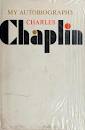
Charlie Chaplin provides quite a contrast, being born into abject poverty and spent much of his childhood in and out of London's Workhouses before his stage work became popular. He remains acutely aware of class struggles and bristles when introduced to someone with the assurance "he comes from a very good family." Chaplin had no patience for the romanticizing of poverty and resented what he called Somerset Maugham's annoying nonsense. This is a great read, which much insight into old Hollywood. I'm going to track down more of his writings, especially the unexpurgated volumes that were published posthumously. It was his great desire that Hitler be laughed at which gives us this most timeless speech: